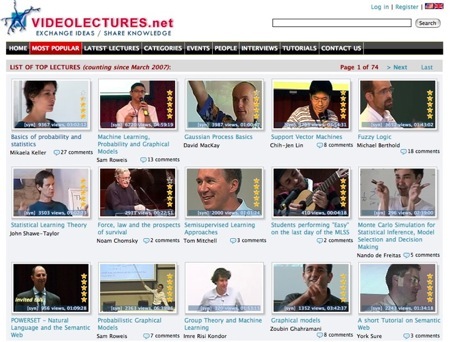
Videolectures was born in 2001 as an internally-funded project at the Jozef Stefan Institute, Slovenia. The pilot project involved videoing the weekly Solomon Lectures held at the institute – regular lectures open to the public on artificial intelligence and general computer science topics. These were made available online in an attempt to enable students and researchers around the world to become part of a global audience.
These initial experiments were so successful that the team behind videolectures began to collaborate with a series of European projects. One of the first and main contributors (both financially and in terms of lectures) was PASCAL, helping videolectures to grow rapidly. PASCAL’s many workshops and links to major conferences contributed several hundred new lectures for the site (three times more than from any other project) providing a valuable resource for PASCAL researchers.
Soon the use of increasingly advanced video streaming technology made videolectures the collaborator of choice for many. In the words of Sebastjan Mislej, videolectures.net provided a “synergy with the global trends and more formal efforts by the European Union in creating a Knowledge Economy and Information Society.”
As videolectures was seen to provide quality recordings for existing projects, the team were increasingly approached to become involved with new projects. Over the next few years, videolectures.net joined forces with a series of Framework 5, 6 and 7 projects. The list of projects is a long one. In addition to the biggest contributor: PASCAL, the list of collaborators also includes projects such as: |
SEKT (Semantically-Enabled Knowledge Technologies), ECOLEAD (European Collaborative Networked Organisations Leadership Initiative), NEON (Lifecycle Support for Networked Ontologies) and EURODICE (European Inter-Disciplinary Research on Intelligent Cargo for Efficient, Safe and Environment-friendly Logistics), and many others. The team also approached major conferences and events and recorded them in full.
Such extensive involvement with so many projects quickly transformed the online resource into a truly global phenomenon covering an impressive range of topics. According to Mislej, “the portal videolectures.net is being used as an educational platform by EU funded research projects on disciplines such as Artificial Intelligence, Machine Learning, Semantic Web, Data Mining. These projects are encompassing different organisations, among others Xerox Parc, British Telecom, Max Planck, Fraunhofer Institute, Australian National University and Carnegie Mellon. The range of countries involved and languages used varies from Ukraine, Europe, USA, Taiwan, Australia and Brazil.” Amazingly, speakers from more than 1700 leading research institutes, companies, academia, governmental and public bodies have contributed their lectures so far.
Videolectures is now run by the dedicated Center for Transfer in Information Technologies at the Jozef Stefan Institute, led by Mitja Jermol since 2003. With experience in research on training for a major publishing house and interests in cutting edge science and novel forms of dissemination, Jermol is perhaps the ideal head for the group. But despite his experience, the videolectures project has had its own unique challenges for Jermol and his team. |