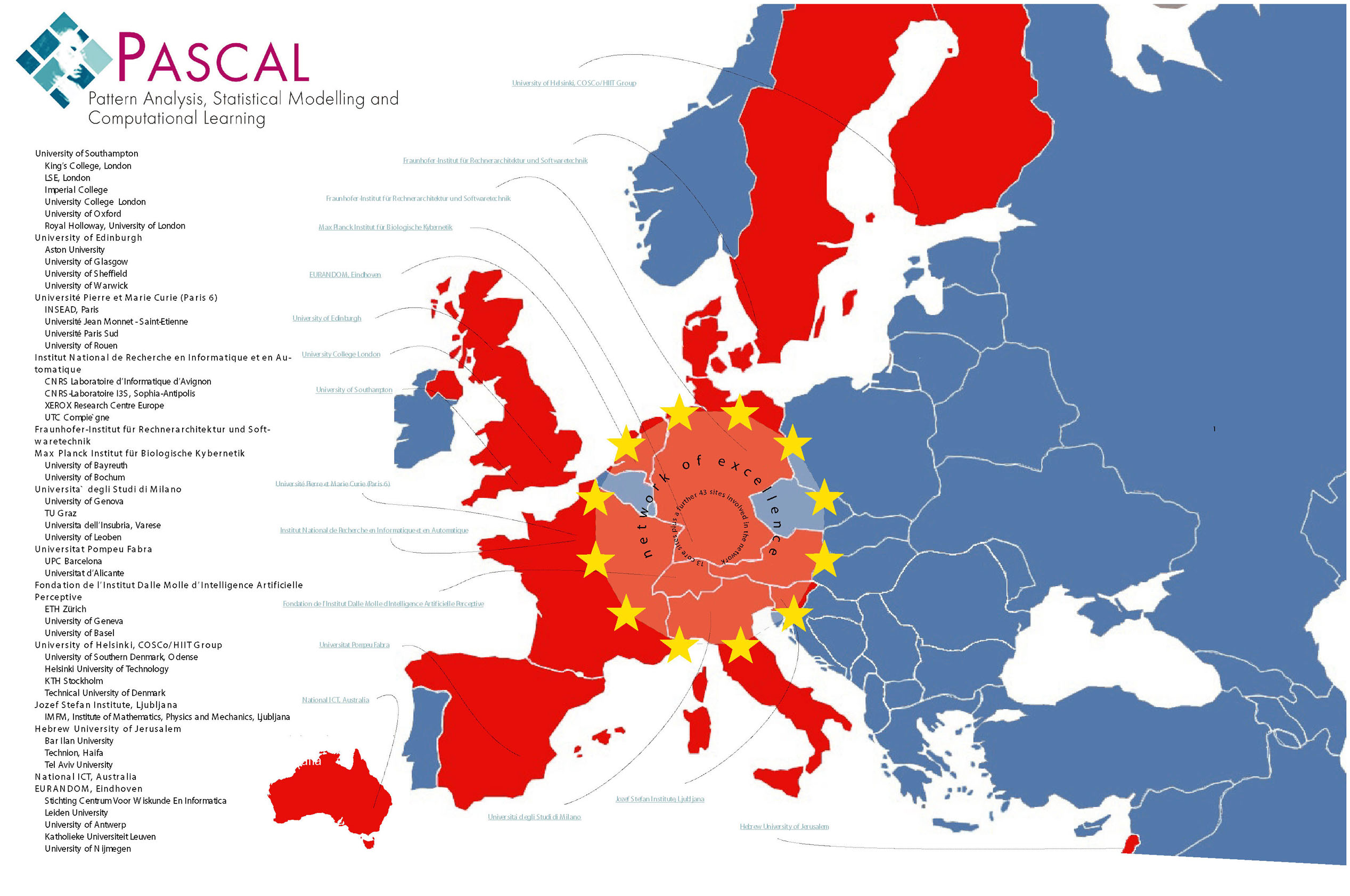
In its four years of existence between 2004 and 2008, PASCAL successfully created the infrastructure of a distributed institute. It is coordinated through an all-embracing web site that enables the managing of its activities through a set of programmes covering activities from Workshop organisation to Curriculum development (see later sections of this brochure). PASCAL has helped create a system for recording events and a repository of the state-of-the-art presentations on research topics covered by the network. It currently contains more than 60 complete events totalling 1253 lectures (see the article on videolectures later). In addition to video, a repository of research papers and technical reports with over 3000 entries produced during the project is maintained. PASCAL also has its own dedicated computing cluster for large scale computing work by network participants.
In an exciting and fast-moving field it is important to support the latest in cutting-edge research. To achieve this, a series of important research themes were identified, and a series of Thematic Programmes were created on the following topics:
• Challenges for Building Multimodal Interfaces
• Interfacing Bayesian and Frequentist Approaches
• Linking Learning and Statistics with Optimisation
• On-line User Modelling and Reinforcement Learning
• Learning with Complex and Structured Outputs
• Intelligent Information Access
• Cognitive learning: language, movement and vision
• Graph Theory Methods in Machine Learning
• Learning in Computational and Systems Biology
Since 2004, the network has organised a series of world-class workshops formed around these themes, resulting in new collaborations and significant new research.
As well as the focus on key thematic areas, PASCAL also encouraged the use of friendly competition amongst research groups in order to improve techniques against common benchmarks. This was enabled by encouraging members, companies or external research groups to organise Challenges around real-world datasets or sets of associated tasks. Each challenge enabled its entrants to submit their solutions to be published in an associated workshop at which the different techniques were presented and results compared. Workshops dedicated to presenting the results of challenges were held in April 2005 and April 2006. Several workshops associated with other challenges were linked to major conferences. The majority of the datasets developed for the challenges have been made available on the web as a permanent resource for researchers working in machine learning or the particular application area. |
|
A distributed research institute can only be as strong as the research that its members perform. PASCAL has a strong philosophy of support and encouragement for new collaborations and new research ideas. To help actively promote both. the network funded a set of “pump-priming” research projects that developed inter-disciplinary research relevant to the themes of PASCAL. These have built collaborations and research results necessary for achieving the goals of the institute, and in several cases have led to further successful research projects with their own independent funding.
The project has generated high quality research relevant to intelligent interfaces, cognitive systems and other applications of machine learning. The one major problem we wished to overcome was the fragmentation of research across different disciplines and countries. Through our workshop programme we succeeded in linking researchers from separate disciplines including machine learning, optimisation and statistics of different schools as well as the associated application areas of machine vision, speech, haptics, brain-computer interface, user-modeling for computer human interaction, multimodal integration, natural language processing, information retrieval and textual information access. This has resulted in concrete collaborations between researchers on particular research topics and challenges, as well as progressing work on multi-modal learning and processing. The management structures of the network encourage creative contributions in both research and organisation of the network. This has established a bottom-up style of organisation with new ideas for challenges, workshops and thematic programmes being generated through relevant calls for proposals.
PASCAL enables Europe to capitalise on its strong research record in the area of principled adaptive systems design. Advanced user interfaces represent one type of application where our expertise is delivering important market advantages that are strengthening European industrial work in this area. The PASCAL distributed institute is also developing other applications of adaptive systems, including cognitive systems (see later sections for more details). It has trained a new generation of professionals to take these methods into other scientific disciplines as well as industrial applications, enabling the exploitation of the vast amount of data now being produced in many domains. |